

Welcome to the Academy of Neuroscience for Architecture
Our beginnings
The Academy of Neuroscience for Architecture (ANFA) grew out of a question that was rarely asked across disciplinary boundaries more than two decades ago: what could architects learn from the rapidly expanding science of how people perceive, navigate, remember, and respond to the world around them?
ANFA began in San Diego in 2002 as a Legacy Project of the American Institute of Architects national convention and was formally established as a nonprofit organization in 2003. From the outset, it brought architects and neuroscientists together to explore how emerging knowledge about perception, cognition, and behavior might deepen our understanding of the built environment.
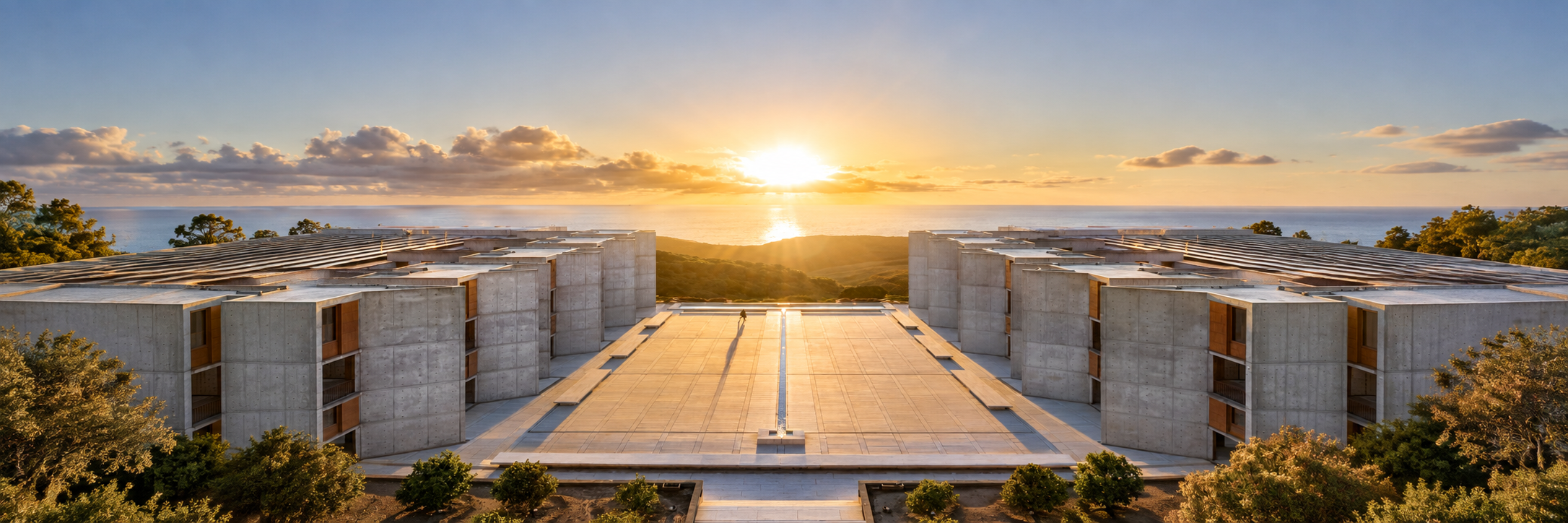
At the 2003 AIA convention, Salk Institute neuroscientist Fred Gage delivered a keynote address on architecture and neuroscience. That same year, ANFA received the AIA College of Fellows’ Latrobe Prize to support a program of research connecting the two fields. Early conferences, workshops, and research initiatives helped establish a new arena for exchange between disciplines that had rarely worked together.
An international community
That early experiment in interdisciplinary exchange has developed into an international community. For more than twenty years, ANFA has created opportunities for architects, scientists, designers, educators, and students to work across disciplinary boundaries and pursue a shared inquiry: how can a deeper understanding of human perception, cognition, and behavior inform the environments we create?
ANFA’s international chapters and affiliated organizations extend this mission across regions, connecting a shared intellectual agenda with local priorities, cultures, and needs. Together, they create a framework for exchange that is global in scope and responsive to regional contexts.
Advancing the field
ANFA advances this work through international conferences, research initiatives, workshops, educational programs, and collaborations among researchers and practitioners. Its mission is not simply to bring neuroscience to architecture, but to create a productive exchange between disciplines that have traditionally approached human experience from very different directions.
Today, that exchange is more important than ever. New methods for studying human experience, rapid advances in neuroscience and computation, and growing recognition of the effects of the built environment on human life are creating possibilities that scarcely existed when ANFA was founded. ANFA provides a place where these developments can meet, where new questions can be formulated, new collaborations can begin, and knowledge can move between research, education, and practice.
Looking ahead
The larger ambition is to help build a deeper understanding of the relationship between people and the environments they inhabit, and to put that understanding in the service of better places for human life.
We welcome researchers, practitioners, educators, institutions, funders, and others interested in advancing this work to reach out to us at [email protected].